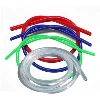
Automotive rubber hoses typically consist of three parts: an inner rubber layer, a reinforcing layer, and an outer rubber layer. The inner rubber layer directly contacts the conveyed medium and needs to be oil-resistant, corrosion-resistant, or heat-resistant. The reinforcing layer generally uses a fiber braided or steel wire winding structure to improve the hose's pressure resistance and tensile strength. The outer rubber layer provides protection, preventing environmental corrosion.
Common materials include nitrile rubber (NBR), ethylene propylene diene monomer (EPDM), and neoprene rubber. EPDM is commonly used in cooling systems due to its excellent high-temperature resistance and aging resistance; NBR is more suitable for fuel systems due to its strong oil resistance.
High-quality materials not only extend the hose's service life but also maintain stable performance in high-temperature, high-pressure, ozone, and ultraviolet environments, thus ensuring reliable operation of the vehicle under various complex conditions.