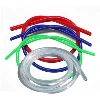
The manufacturing process of braided silicone hoses includes raw material preparation, rubber mixing and compounding, extrusion molding, braiding and reinforcement, vulcanization, inspection and quality control, and subsequent processing and packaging.
Raw materials include silicone rubber, fillers, additives, and vulcanizing agents. Rubber mixing is carried out in a two-roll mill, adding vulcanizing agents and silicone masterbatch, and uniformly mixing through shearing and extrusion. Extrusion molding uses a silicone extruder and molds, controlling the extrusion speed and pressure to ensure dimensional accuracy.
The braided layer is made of high-strength fibers, uniformly wound onto the silicone hose using a braiding machine, with adjustable braiding density. Braiding materials can include fiber yarn, nylon yarn, thermally conductive wire, steel wire, etc. It is worth noting that some products (such as externally braided silicone hoses) may not have an outer rubber coating, with the braided layer directly exposed to meet specific application requirements or appearance requirements, but this may affect the product's strength to some extent.
After the product is braided, it needs to be re-extruded to wrap the braided yarn. Vulcanization cross-links the silicone rubber molecular chains. The vulcanization temperature is approximately 180 degrees Celsius for ordinary silicone rubber and approximately 200 degrees Celsius for fumed silicone rubber, with a vulcanization time of approximately 2 hours. Inspection includes visual inspection, wall thickness measurement, quality testing, and performance testing. Subsequent processing includes shearing, bonding, and drilling. Packaging must be moisture-proof, dust-proof, and scratch-proof, and product information must be clearly labeled.