Automotive Brake Hose: Why Pressure Resistance and Flexibility Must Work Together
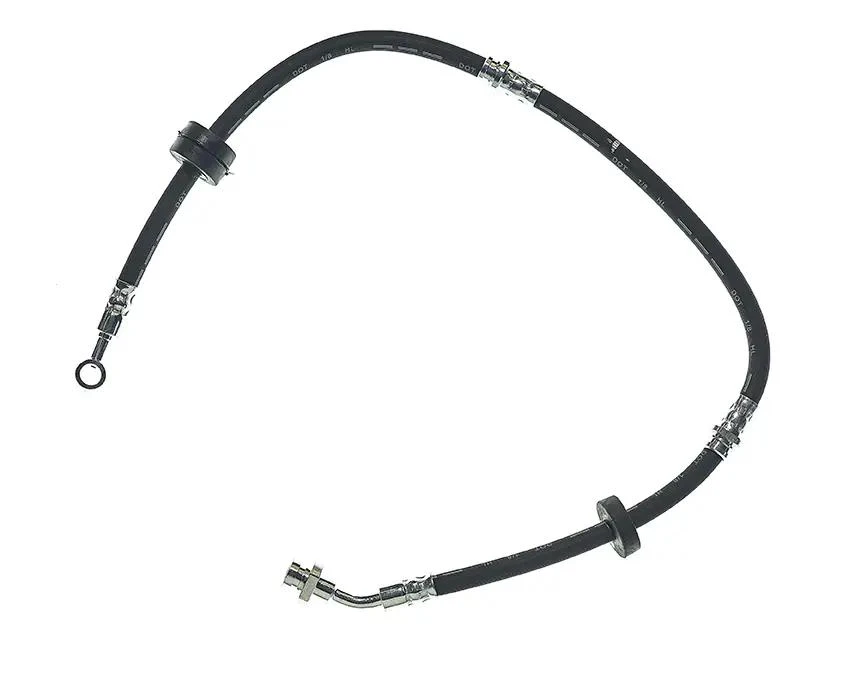
An automotive brake hose is a critical component in a vehicle's braking system. It provides a flexible connection between rigid brake pipes and moving components, allowing hydraulic brake fluid to reach the wheel brake assembly while accommodating steering and suspension movement.
Unlike an ordinary rubber hose, an automotive brake hose operates under demanding conditions. It must withstand repeated hydraulic pressure, maintain its structural integrity, resist expansion, and remain flexible enough to accommodate continuous movement during vehicle operation.
These requirements create an important design challenge: a brake hose must be strong enough to contain brake fluid pressure, but also flexible enough to function in a moving vehicle.
The balance between pressure resistance and flexibility is one of the key factors that determines the suitability of a hydraulic brake hose. Understanding this relationship helps automotive parts buyers, distributors, and OEM purchasers evaluate brake hose products more accurately.
1. The Role of an Automotive Brake Hose in Hydraulic Braking
Most conventional passenger vehicles use hydraulic braking systems. When the driver presses the brake pedal, the master cylinder generates hydraulic pressure and transfers it through brake fluid to the wheel brake mechanisms.
Rigid brake pipes are commonly used along fixed sections of the vehicle because they provide a stable route for hydraulic fluid. However, not every part of the braking system remains stationary.
The wheels move in response to steering and suspension travel. The distance and relative position between the vehicle body and wheel assembly can change as the vehicle turns, accelerates, brakes, or travels over uneven surfaces.
A flexible brake hose connects these moving sections to the rigid brake line network.
Its main functions include:
Transmitting hydraulic brake fluid between connected components.
Accommodating steering movement at the front wheels.
Allowing suspension movement without placing excessive tension on the brake line.
Maintaining a sealed hydraulic passage during repeated braking cycles.
Providing a flexible connection where rigid tubing would not be suitable.
This makes the automotive brake hose an important link between the fixed and moving sections of the hydraulic braking system.
The hose is not simply a flexible extension of a metal pipe. It is a purpose-designed component that must meet specific requirements for pressure containment, dimensional stability, flexibility, fluid compatibility, and durability.
2. Why Pressure Resistance Is Not the Only Performance Requirement
Hydraulic brake systems rely on the transmission of fluid pressure. When the driver applies the brake pedal, pressure is generated within the hydraulic circuit and transmitted to the wheel brakes.
The brake hose must contain this pressure without leaking, rupturing, or experiencing unacceptable deformation.
However, pressure resistance alone does not fully describe brake hose performance.
A hose may remain intact under pressure but still exhibit excessive expansion. When internal pressure increases, the hose wall is subjected to forces that can cause it to expand slightly.
Some dimensional change is inherent in flexible hose construction. The important consideration is whether the expansion remains within the limits established by the applicable product requirements.
How excessive expansion affects braking response
When a hydraulic brake hose expands more than intended, part of the displaced brake fluid volume is used to expand the hose rather than being transmitted directly to the wheel brake mechanism.
This can contribute to additional brake pedal travel or a less direct pedal response, depending on the overall braking system and the extent of hose expansion.
For this reason, controlling volumetric expansion is an important part of hydraulic brake hose design.
A suitable brake hose needs to combine:
Adequate pressure resistance.
Controlled expansion under pressure.
Stable internal dimensions.
Reliable bonding between its structural layers.
Consistent performance over repeated pressure cycles.
This is why selecting a brake hose based only on a stated pressure rating is not sufficient. Buyers should also consider the relevant expansion requirements and performance testing for the complete hose assembly.
How the Reinforcement Structure Helps Control Hose Expansion
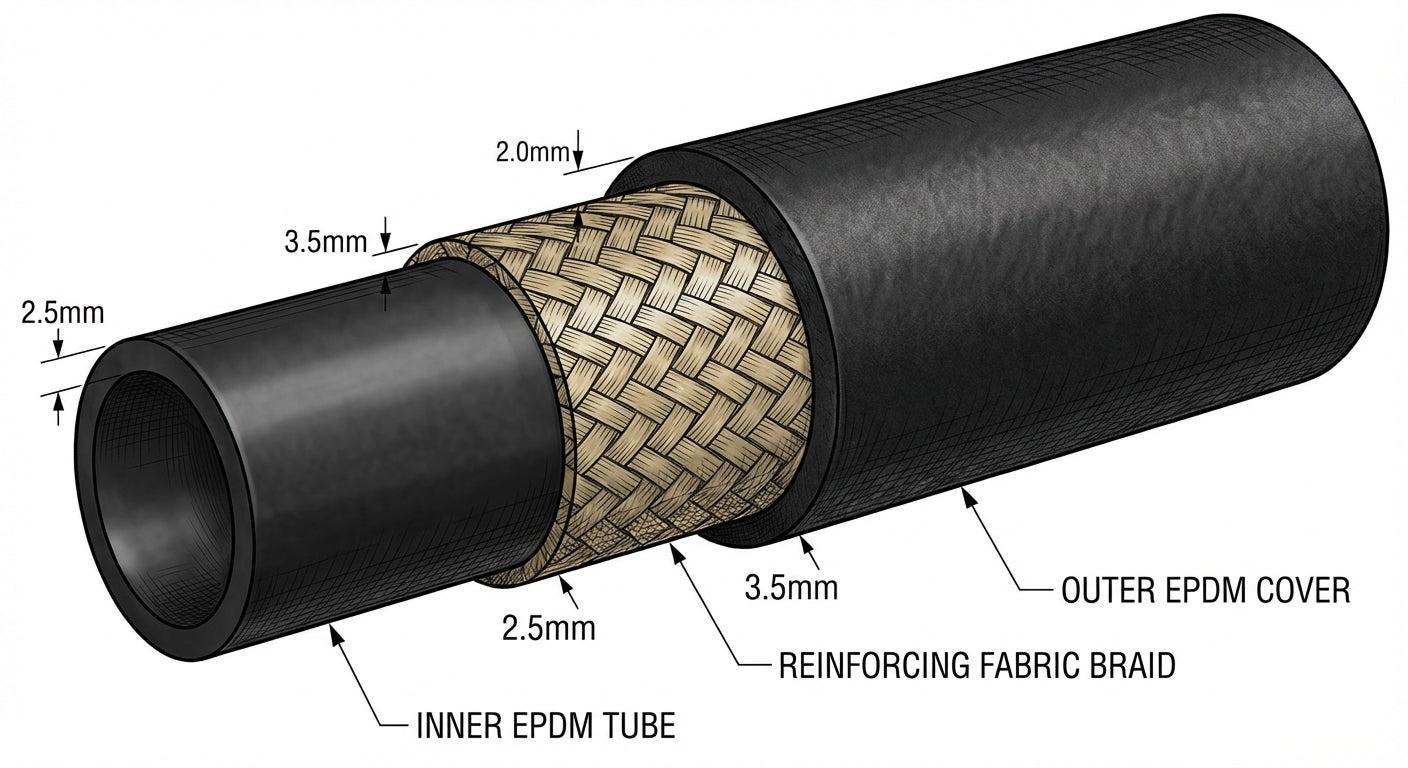
The reinforcement structure plays an important role in the mechanical performance of an automotive hydraulic brake hose.
A typical rubber brake hose construction may include an inner tube, a reinforcement layer, and an outer protective cover. The exact materials and construction depend on the product specification and applicable requirements.
Each part has a different function.
Inner tube: compatibility with brake fluid
The inner tube forms the passage through which brake fluid travels.
Its material must be compatible with the specified brake fluid and maintain its integrity under the expected operating temperature and pressure conditions.
Brake fluid compatibility is especially important because unsuitable materials may swell, soften, harden, or deteriorate after prolonged exposure.
A material that performs well in a general-purpose rubber hose should not automatically be considered suitable for hydraulic brake applications.
Reinforcement layer: supporting pressure stability
The reinforcement layer helps the hose resist internal pressure and control expansion.
Depending on the construction, reinforcement may use suitable textile yarns or other specified structural arrangements.
Its design influences the hose's ability to maintain dimensional stability during pressure application and repeated braking cycles.
The reinforcement must also work effectively with the inner tube. Poor bonding or inconsistent construction can affect the integrity of the complete hose structure.
Outer cover: protecting the hose externally
The outer cover helps protect the hose against external environmental and mechanical influences.
In a vehicle, the brake hose may be exposed to moisture, dirt, road debris, temperature changes, and contact risks around suspension and wheel components.
The outer cover therefore needs to be appropriate for the intended installation environment.
It is important to understand that the three layers do not work independently. The complete construction must provide the required pressure performance, fluid compatibility, flexibility, and external protection.
4. Why Brake Hoses Must Remain Flexible During Steering and Suspension Movement
One of the main differences between an automotive brake hose and a fixed hydraulic pipe is the movement that the hose must accommodate.
A vehicle's wheel assembly does not remain in one position during operation.
At the front axle, steering movement changes the orientation of the wheel and its associated brake components. Suspension travel also changes the relative position between the wheel assembly and vehicle body.
A flexible brake hose must accommodate these movements without becoming stretched, twisted, sharply bent, or trapped between surrounding components.
Steering movement
When the front wheels turn, the brake hose follows the movement of the wheel-side brake assembly.
The hose needs sufficient flexibility and appropriate routing to accommodate the full steering range. If the hose is too short or incorrectly positioned, it may experience tension or interference at certain steering angles.
Suspension travel
As the suspension moves, the distance between the body-mounted brake line and the wheel assembly changes.
The brake hose must accommodate this movement throughout the intended suspension travel.
A hose that is routed incorrectly may become stretched when the suspension reaches a particular position. In other cases, excessive slack may allow the hose to contact nearby components.
Combined movement
Steering and suspension movement can occur together.
Therefore, brake hose routing should not be evaluated only when the vehicle is stationary or when the wheels are in a straight-ahead position.
The complete installation needs to account for the movement range specified by the vehicle design.
This is one reason why automotive brake hoses are often developed for specific vehicle applications rather than selected solely by diameter and length.
5. Repeated Flexing and Long-Term Mechanical Durability
A brake hose may experience thousands of operating cycles throughout its service life.
Every steering movement, suspension movement, and braking event can contribute to changes in its mechanical loading.
The hose therefore needs to maintain its properties under repeated operation.
Several conditions can influence its long-term durability.
Repeated bending
Repeated bending places mechanical stress on the hose wall and reinforcement structure. The location and severity of bending depend on the installation route and the amount of movement.
Twisting
Twisting during installation can create uneven stress across the hose structure. It may also affect the hose's position as the wheel and suspension move.
Abrasion
If the hose repeatedly contacts a bracket, wheel component, or another surface, the outer cover may gradually wear.
Temperature changes
Brake hoses operate in an environment where temperatures can change due to ambient conditions, nearby components, and braking-related heat. The material system must be suitable for the specified temperature range.
Pressure cycling
Brake pressure rises and falls during normal vehicle operation. The hose assembly must be designed and tested for the repeated pressure conditions specified by the relevant requirements.
These factors show why a brake hose should be evaluated as a dynamic component rather than a simple pressure-carrying tube.
A product that performs adequately in a static pressure test may still require additional assessment for repeated movement, bending, and environmental exposure.
Why the Complete Brake Hose Assembly Matters
The performance of an automotive brake hose depends not only on the flexible hose body but also on its end fittings and assembly quality.
A brake hose assembly generally includes the hose and permanently attached metal end fittings. Depending on the vehicle design, it may also include brackets, protective sleeves, or other supporting components.
The connection between the hose and fittings is particularly important because it must maintain a secure, sealed joint under hydraulic pressure and mechanical movement.
End fitting design
The fitting type, connection dimensions, orientation, and mounting arrangement must match the vehicle's braking system.
Even a correctly manufactured hose may be unsuitable if its end fittings do not match the original connection requirements.
Crimping or swaging
Many hydraulic brake hose assemblies use permanently attached fittings secured through a controlled crimping or swaging process.
The assembly process must be appropriate for the hose and fitting design. Incorrect assembly dimensions or inconsistent processing may affect retention and sealing performance.
Fitting orientation
The orientation of the fittings influences how the hose sits after installation.
If the hose is forced into an unsuitable position because of incorrect fitting orientation, it may become twisted or experience additional bending stress.
Protective sleeves and brackets
Some brake hose assemblies include protective components to support installation and reduce exposure to abrasion or other mechanical damage.
These components should be considered part of the complete application design where specified by the original vehicle configuration.
For OEM replacement projects, matching the original assembly configuration is often as important as matching the hose dimensions.
7. What Buyers Should Check When Sourcing Automotive Brake Hose
For automotive parts distributors, importers, and OEM purchasers, a clear technical specification helps reduce the risk of selecting an unsuitable brake hose.
When evaluating an automotive brake hose, the following information should be confirmed:
|
Specification |
Why It Matters |
|
Intended vehicle application |
Confirms the vehicle model, axle position, and brake system requirements |
|
Brake fluid compatibility |
Ensures the inner tube is suitable for the specified fluid |
|
Inner diameter |
Matches the required hydraulic passage and assembly design |
|
Outer diameter |
Helps confirm dimensional and installation compatibility |
|
Working pressure and performance requirements |
Establishes the required pressure capability |
|
Volumetric expansion |
Helps evaluate dimensional stability under pressure |
|
Temperature range |
Confirms suitability for the intended operating environment |
|
Minimum bending radius |
Helps prevent excessive bending during installation |
|
Hose length |
Ensures sufficient movement allowance without excessive slack |
|
End fitting type |
Confirms compatibility with the vehicle's brake line connections |
|
Fitting orientation |
Helps achieve the correct installation position |
|
Assembly construction |
Confirms the hose, reinforcement, fittings, and protective components |
|
Applicable standards |
Establishes the required testing, identification, and compliance criteria |
For replacement products, the original part number, vehicle application, hose length, fitting photographs, and connection details can help identify the correct configuration.
For customized or OEM projects, technical drawings and physical samples provide a more reliable basis for confirming dimensions and fitting arrangements.
Because brake hoses are safety-critical components, buyers should verify documented product performance and applicable regulatory requirements rather than relying on visual similarity or general-purpose hose specifications.
8. Understanding Brake Hose Standards and Product Requirements
Automotive brake hoses are subject to specific performance and identification requirements.
For example, SAE J1401 addresses hydraulic brake hose assemblies used in road vehicle braking systems with specified non-petroleum-base hydraulic brake fluids. It covers performance testing and requirements for the hose assembly, as well as manufacturer identification.
In the United States, FMVSS No. 106 establishes requirements for motor vehicle brake hoses, brake hose assemblies, and end fittings. Its scope includes hydraulic, air, and vacuum brake hose applications.
These standards should be considered according to the intended market and product category. Meeting a general rubber hose specification does not establish compliance with automotive brake hose requirements.
Buyers should confirm:
Which standard applies to the target market.
Whether the requirement applies to the hose itself or the complete hose assembly.
Which brake fluid types are covered.
Whether the required testing and identification are documented.
Whether the end fittings and assembly configuration meet the relevant requirements.
A brake hose specification should be based on the actual vehicle application and applicable standards, not simply on a product description such as high-pressure rubber hose.
9. Choosing the Right Automotive Brake Hose
A reliable automotive brake hose must perform several functions at the same time.
It needs to contain hydraulic pressure, control expansion, remain compatible with the specified brake fluid, and accommodate steering and suspension movement. Its end fittings and assembly configuration must also match the intended vehicle application.
This combination of requirements makes brake hose selection different from selecting a general-purpose rubber hose.
For buyers, the most effective approach is to start with the vehicle application and original assembly specifications. Pressure performance, volumetric expansion, flexibility, fitting dimensions, and applicable standards should then be evaluated together.
By considering the complete hose assembly rather than focusing on one specification alone, automotive parts buyers can make more informed sourcing decisions and better assess product suitability for hydraulic braking systems.