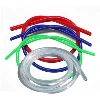
A silicone tube does not always need reinforcement. For applications where the tube mainly needs to provide a flexible flow path, an extruded silicone tube may be sufficient.
However, when the tubing needs to handle higher pressure, resist deformation, or maintain greater dimensional stability, a reinforced construction can provide an important difference.
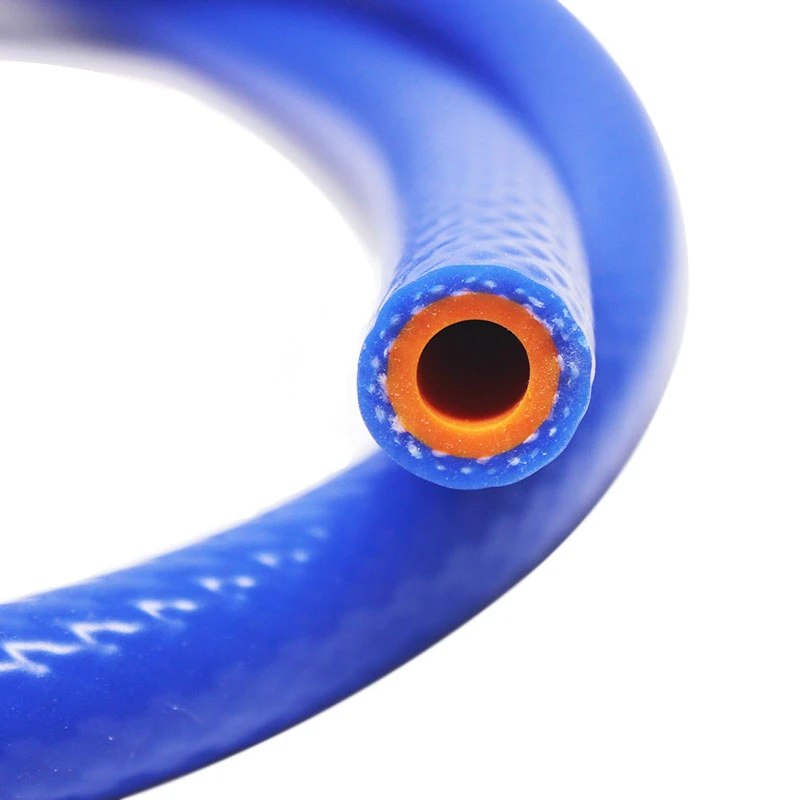
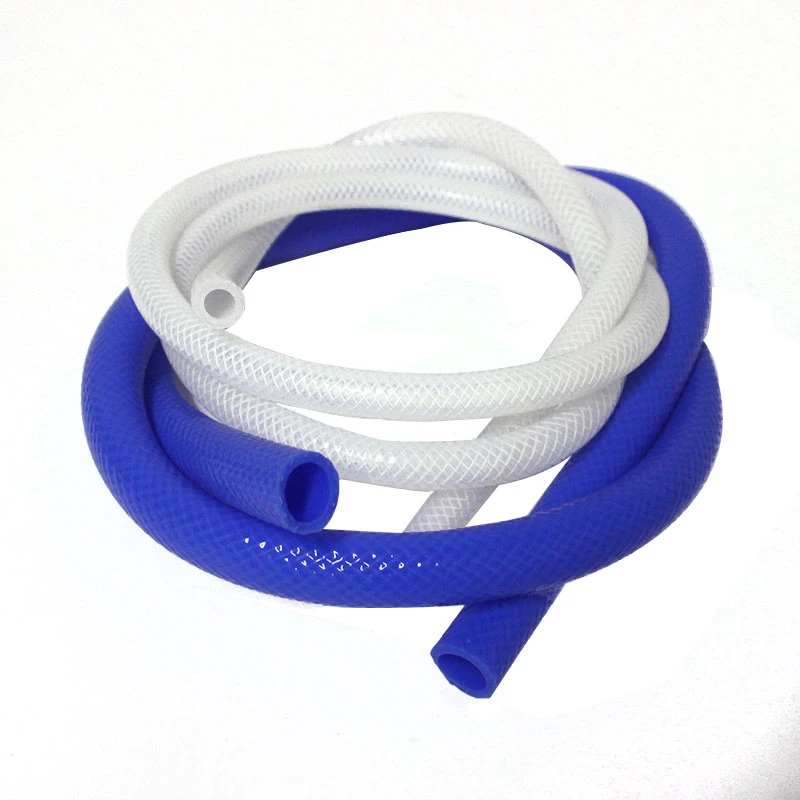
A Food Grade Fiber Reinforced Silicone Tube combines a silicone inner and outer structure with a fiber reinforcement layer between them. The purpose of this construction is not simply to make the tube stronger. It changes how the tube behaves under working conditions.
Reinforcement Helps Control Expansion
When pressure is applied inside a flexible tube, the tube wall can tend to expand.
For a low-pressure application, a certain amount of expansion may not create a practical problem. As working pressure increases, however, excessive expansion can affect the stability of the tubing and its connections.
Fiber reinforcement helps restrict this deformation.
The reinforcement layer provides additional structural support around the silicone tube, allowing it to maintain its intended shape more effectively under pressure.
This can be particularly useful when the tubing needs to remain flexible while also handling pressure that would be unsuitable for an unreinforced silicone tube.
Flexibility Still Matters
Adding reinforcement does not mean the tubing should become rigid.
One of the useful characteristics of reinforced silicone tubing is the combination of structural support and flexibility.
The tube still needs to be routed, connected, and handled during installation. If the construction is unnecessarily stiff for the application, installation can become more difficult.
The reinforcement therefore needs to be designed according to the required working conditions rather than simply maximizing the amount of reinforcement.
The fiber type, braid structure, number of reinforcement layers, wall thickness, and tube dimensions can all influence the final behavior of the product.
Pressure Should Be Considered Together With Temperature
Pressure is rarely the only operating condition.
In many food and beverage systems, the tubing may experience temperature changes during production, cleaning, or sanitizing. The material properties of the silicone and reinforcement structure need to remain appropriate for the actual temperature range.
A specification based only on room-temperature pressure may therefore give an incomplete picture.
When selecting a Food Grade Fiber Reinforced Silicone Tube, it is useful to establish both the normal working pressure and the temperature conditions under which that pressure occurs.
Repeated pressure and temperature cycles should also be considered where applicable.
Do Not Use Reinforcement as a Substitute for Correct Sizing
A reinforced tube is not automatically the right choice for every pressure application.
Inside diameter still needs to match the required flow and connection dimensions. Wall thickness, fitting size, hose length, and installation method also influence the finished system.
For example, selecting a reinforced tube with an unsuitable inside diameter can create connection problems even if its pressure capability is otherwise appropriate.
The reinforcement should solve a specific requirement rather than compensate for an incorrect basic specification.
Check the Connections Carefully
The connection is often one of the most important parts of a reinforced tubing installation.
The tube needs to fit the selected fitting correctly, and the clamp or connection method needs to be compatible with the tube's outside diameter and wall construction.
During installation, avoid excessive bending directly next to the fitting. A sharp bend at the connection can place additional mechanical stress on the tube.
After installation, check that the tube is not twisted, sharply kinked, or under unnecessary tension.
When Reinforced Silicone Tubing Makes Sense
A Food Grade Fiber Reinforced Silicone Tube can be considered when an application requires a combination of silicone's flexibility and temperature performance with additional structural support.
Typical considerations include:
Working pressure
Temperature range
Pressure fluctuations
Required flexibility
Tube diameter
Connection method
Cleaning conditions
Applicable food-contact requirements
The correct construction depends on the complete operating environment.
For B2B applications, Haidu provides Food Grade Fiber Reinforced Silicone Tube solutions with different diameters, wall thicknesses, reinforcement structures, lengths, and configurations according to specific application and OEM/ODM requirements.
For food-contact applications, the intended medium, operating conditions, cleaning process, and applicable compliance requirements should be confirmed before production.